
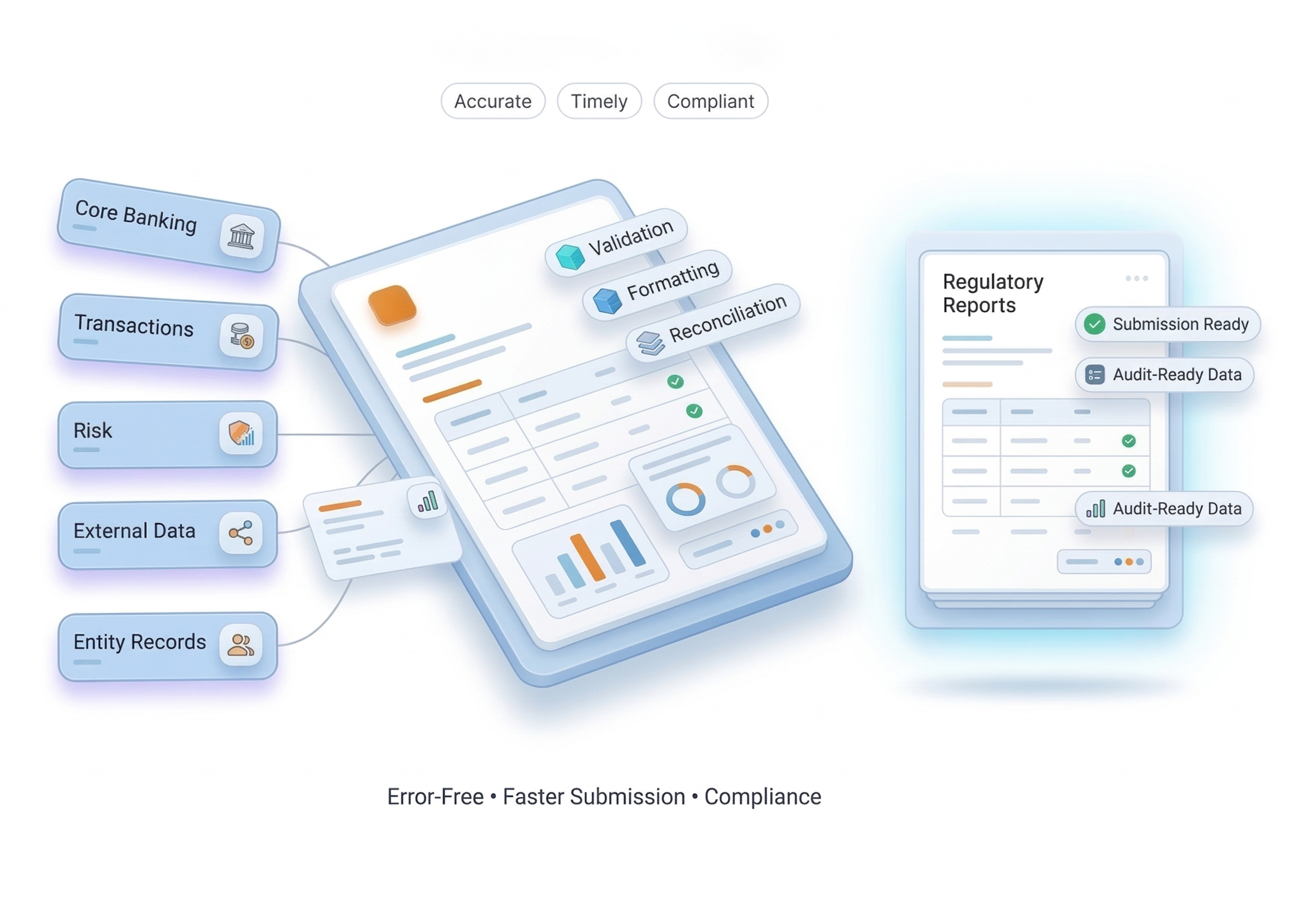
Financial institutions must submit large volumes of regulatory data to central banks within strict timelines and fixed formats. Data is often spread across multiple systems, making reporting complex, time-consuming, and prone to errors.
SIAS-DWH Central Bank Reporting by Rumango provides a centralized reporting environment that consolidates data into a single governed repository. It helps institutions prepare, validate, and submit regulatory reports efficiently while maintaining accuracy and compliance.
Want to streamline your central bank reporting process?
Get StartedSIAS-DWH Central Bank Reporting is a next-generation regulatory reporting capability built on Rumango’s enterprise data warehousing and data lake platform. It collects, standardizes, and reconciles data from multiple banking systems before transforming it into regulator-specific formats. AI-driven processing and machine learning models support data quality validation, anomaly detection, and reconciliation checks to improve reporting accuracy and reduce rework.
SIAS-DWH provides a governed reporting layer that securely connects with internal banking systems and central bank submission platforms while ensuring full traceability, data integrity, and audit readiness.
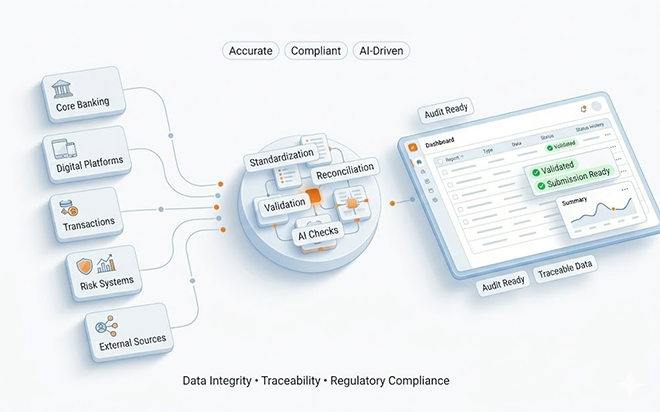

A centralized framework extracts data from core banking, risk, treasury, and operational systems, harmonizing formats and structures to meet central bank reporting requirements. This reduces manual compilation effort and improves consistency across submissions.

Machine learning models analyze data patterns, compare values across sources, identify discrepancies, and flag anomalies before submission. This strengthens overall accuracy, reduces reporting errors, and supports proactive issue resolution by allowing teams to correct inconsistencies early in the process.

Built-in governance policies, version control, role-based access, and detailed audit trails ensure every report remains compliant, traceable, and aligned with regulatory and institutional standards. This provides clear accountability, improves audit readiness, and enhances confidence in every submission.

Automated data preparation shortens reporting cycles, reduces manual effort, and improves on-time regulatory compliance. This allows reporting teams to focus on analysis rather than manual compilation, improving overall efficiency and reliability.

Centralized validation and reconciliation minimize errors, inconsistencies, and last-minute reporting issues. This lowers the risk of regulatory findings, rework, and operational disruptions during critical reporting periods.

Clear audit trails, data lineage tracking, and governance controls enhance credibility and trust with regulators. This ensures full traceability of data from source to submission, supporting accountability and regulatory confidence.

Automation reduces dependency on manual processes, spreadsheets, and ad-hoc data collection.

Continuous validation improves overall data reliability beyond regulatory reporting.

A flexible data platform supports growing reporting requirements, new regulations, and additional data sources without performance strain.
Let’s help you build a secure, scalable, and intelligent reporting framework that ensures accuracy, compliance, and confidence in every central bank submission.
Get Started